Break Apart Method For Multiplication: A Step‑by‑Step Guide
The Break Apart Method for Multiplication, also known as the Decompose Multiplication Strategy, is a simple yet powerful technique that helps students tackle multiplication problems by breaking them into smaller, more manageable pieces. This approach is especially useful for mental math, teaching foundational skills, and building confidence in early learners.
What Is the Break Apart Method?
When you “break apart” a number, you decompose it into parts that are easier to multiply. Instead of multiplying large numbers directly, you split them into sums or differences that align with the base of ten or other convenient values. The method relies on the distributive property of multiplication over addition:
A × (B + C) = (A × B) + (A × C)
By applying this property, you can simplify complex calculations into a series of smaller multiplications and additions.
Why Use the Break Apart Method?
- Reduces cognitive load: Smaller numbers are easier to handle mentally.
- Builds number sense: Learners see relationships between numbers and base‑ten structures.
- Facilitates error checking: Each sub‑product can be verified independently.
- Supports diverse learning styles: Visual, auditory, and kinesthetic learners can engage with the method differently.
Step‑by‑Step Tutorial on How to Use the Break Apart Method
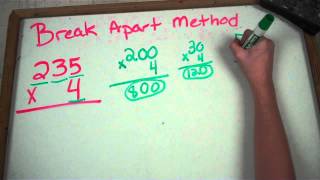
This video covers a practical demonstration of the technique. Below is a written step‑by‑step guide that mirrors the visual instructions:
-
Choose a multiplication problem.
Example: 7 × 13.
-
Decide which number to break apart.
It is often easiest to break apart the smaller or the one with a clear base‑ten component. Here we’ll break apart 13 into 10 + 3.
-
Apply the distributive property.
Rewrite the multiplication:
7 × 13 = 7 × (10 + 3).
-
Multiply each part separately.
- 7 × 10 = 70
- 7 × 3 = 21
-
Add the partial products.
70 + 21 = 91.
-
Verify the result.
Double‑check by multiplying directly or using a calculator. The answer 91 is correct.
That’s the entire process: decompose, distribute, multiply, and combine.
More Complex Examples
Let’s apply the method to a slightly larger problem: 24 × 46.
- Break one factor into base‑ten components: 46 = 40 + 6.