Inequalities Key Words: A Clear Guide for Students and Teachers
Understanding inequalities key words is essential for mastering algebra and solving real‑world problems. These words tell you whether a relationship is greater than, less than, or equal to another value, and they appear in textbooks, worksheets, and video lessons alike. This article explains the most common key words, shows how to identify them, and offers practical tips for using them effectively in the classroom.
Why Key Words Matter in Inequalities
When a problem states “the temperature must be at most 30°C,” the phrase “at most” signals a “≤” relationship. Recognizing such cues prevents misinterpretation and saves time on test day. In this video we’re going to discuss some typical phrases and how they translate into mathematical symbols, so you can quickly convert word problems into algebraic expressions.
Common Inequalities Key Words and Their Symbols
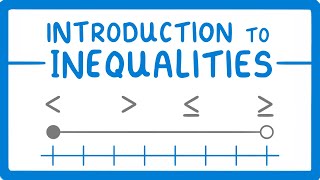
Below is a concise list that highlights the most frequently used words and the symbols they represent. Memorizing this list is a quick way to boost confidence when reading math problems.
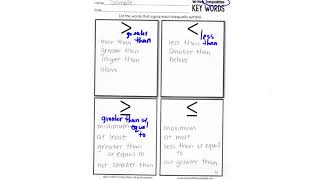
- Greater than – “more than,” “exceeds,” “over,” “greater than” → >
- Less than – “under,” “fewer than,” “less than,” “below” → <
- Greater than or equal to – “at least,” “no less than,” “minimum of,” “greater than or equal to” → ≥
- Less than or equal to – “at most,” “no more than,” “maximum of,” “less than or equal to” → ≤
- Not equal to – “different from,” “not equal to,” “does not equal” → ≠
How to Identify Key Words in Context
Key words often appear in sentences that describe limits, ranges, or comparisons. Here are three strategies to spot them:
- Look for comparative adjectives. Words such as “greater,” “less,” “more,” and “fewer” usually indicate an inequality.
- Notice qualifiers. Phrases like “at least” or “no more than” add the “or equal to” component.
- Check for negations. The word “not” before “equal” creates the “≠” sign.
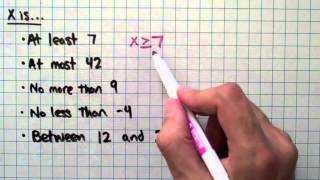
For example, the sentence “Students must score at least 80 points” translates to x ≥ 80. Recognizing “at least” as a key word instantly tells you the correct inequality.
Applying Key Words in Real‑World Situations
Teachers often use practical examples to help students internalize concepts. Here is a short scenario that can be used in a classroom activity:
Scenario: A school bus can hold a maximum of 55 passengers. If p represents the number of passengers, the inequality is