Understanding Negatives in Sentences
Negatives are a fundamental part of English grammar, yet they often cause confusion for learners at every level. Whether you are writing an essay, speaking with a friend, or teaching a classroom, mastering the use of negative words such as “not”, “no”, “don’t”, and “didn’t” can dramatically improve clarity and confidence.
Why Negatives Matter
Using negatives correctly helps you:
- Express disagreement or denial precisely.
- Avoid unintended meanings that can change the tone of a sentence.
- Build more complex sentences, especially when combining ideas.
In many English‑learning contexts, students mistakenly mix up these forms. Do you make mistakes with “don’t”, “no”, “not” and “didn’t”? You are not alone. The confusion often stems from the way negatives interact with verbs, nouns, and other modifiers.
Common Types of Negatives
1. Simple Negatives
Simple negatives are formed by adding “not” to an auxiliary verb or by using a negative contraction.
- Not + auxiliary: She is not coming.
- Negative contraction: They don’t like coffee.
- Negative adverb: He never arrives early.
2. Negative Pronouns and Determiners
Words such as “no”, “none”, “nobody”, “nothing”, and “neither” replace nouns or pronouns.
- No tickets are available.
- None of the answers were correct.
- Nobody called back.
3. Double Negatives
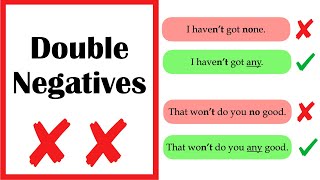
A double negative occurs when two negative forms appear in the same clause, often creating an unintended positive meaning. This tutorial covers double negatives in depth because they are a frequent source of error.
Example of a problematic double negative:
I don’t have no money. (Standard English interprets this as “I have some money.”)
In most formal contexts, a single negative is preferred:
I don’t have any money