Scientific Notation in English: A Practical Guide
Scientific notation, also known as exponential notation, is a compact way to represent very large or very small numbers. It is widely used in science, engineering, and mathematics to simplify calculations, improve readability, and reduce the risk of errors. This article provides a clear, step‑by‑step overview of how to write, read, and convert numbers using scientific notation.
Why Use Scientific Notation?
- Clarity: Large values like the speed of light (3.00 × 10⁸ m/s) or tiny masses such as the electron (9.11 × 10⁻³¹ kg) become easier to compare.
- Efficiency: Calculations with extreme values are streamlined, especially in computer programming and spreadsheets.
- Standardization: Scientific notation is the accepted format in academic publications, technical reports, and data sheets.
The Basic Structure
In English, a number in scientific notation takes the form:
- Significand (coefficient): a decimal number between 1 (inclusive) and 10 (exclusive).
- Base: the number 10.
- Exponent: an integer that indicates how many places the decimal point moves.
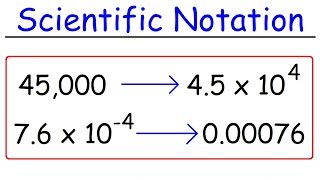
Example: 4.56 × 10³ means 4.56 multiplied by 1,000, which equals 4,560.
Converting to Scientific Notation
Follow these steps to convert any ordinary decimal or whole number:
- Place the decimal point so that the resulting number is between 1 and 10. Count how many places you moved the point.
- Write the new number as the significand.
- Set the exponent to the number of places moved. Use a positive exponent if the decimal moved left (for large numbers); use a negative exponent if it moved right (for small numbers).
Example 1: Large Number
- Number: 7,890,000
- Step 1: 7.890 (move decimal 6 places left)
- Step 2: 7.890
- Step 3: 106
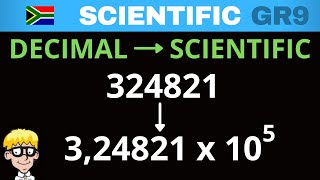
- Result: 7.890 × 10⁶
Example 2: Small Number
- Number: 0.0000452
- Step 1: 4.52 (move decimal 5 places right)
- Step 2: 4.52
- Step 3: 10−5
- Result: 4.52 × 10